
Technical symposium · Arnhem
CFD fire simulations: capabilities, limitations, and quality assurance
More than 100 fire safety professionals gathered in Arnhem to examine how modelling choices, oxygen-controlled fires, façade scenarios, and user expertise influence CFD simulation results.
15 May 2024
NIPV · Arnhem, the Netherlands
100+ attendees
Strong professional engagement
New guidance
Assessing CFD simulation quality
Expert debate
Transparency and qualifications
On 15 May 2024, more than 100 professionals attended a symposium on CFD fire simulations in Arnhem. The event brought organisations from across the Dutch fire safety community together, including the Netherlands Institute for Public Safety (NIPV), VVBA, SFPE Benelux, and IFE Netherlands.
The programme examined both the value and limitations of computational fluid dynamics in fire safety engineering. Presentations and discussion showed why technically credible results depend not only on software, but also on modelling choices, validation, transparent reporting, and the competence of the engineer.
A CFD model does not create certainty by itself: reliable conclusions require sound assumptions, skilled users, and transparent assessment.
Updated guidance for assessing CFD simulations
The symposium marked the publication of the second version of NIPV’s Guidance on Assessing CFD Simulations. The document supports reviewers and practitioners in examining the quality, assumptions, documentation, and interpretation of CFD studies.
Clear assessment criteria are important because CFD outcomes can appear precise while still being sensitive to input, modelling decisions, numerical settings, and the questions a study is intended to answer.
What CFD fire simulations can-and cannot-do
David den Boer from Peutz introduced the background and calculation principles of CFD. His presentation addressed the capabilities of CFD fire modelling, the situations in which users should be cautious, and the practical challenges that engineers encounter when translating a physical fire scenario into a numerical model.

How modelling choices influence CFD results
In his presentation on modelling choices, Richard van de Nes demonstrated how decisions made by the user can significantly change the final simulation results. Visual comparisons made the influence of these choices particularly clear.
The session reinforced a central message from the assessment guidance: assumptions and model settings must be documented and justified so reviewers can understand how the results were produced and whether they are suitable for the intended decision.
Simulating oxygen-controlled fires with FDS
Pim van Rede from NIPV presented research from his master’s thesis at Ghent University. The central question was whether strongly oxygen-controlled fires can be simulated reliably.
His work indicated that adjustments to Fire Dynamics Simulator settings can produce reasonably accurate results for certain oxygen-controlled scenarios. However, no single group of settings performed well for every scenario or requested output. This underlines the importance of selecting and validating settings for the specific modelling objective.
Why façade fires remain difficult to predict
Paul Hoondert from DGMR discussed the challenge of predicting façade fire tests using CFD. Modelling medium-scale façade tests with the present state of the technology does not yet provide sufficiently accurate predictions of façade fire behaviour.
Recognising this limitation is itself essential engineering knowledge. A model should not be used beyond the range in which its assumptions and validation evidence support reliable conclusions.
Transparency and qualifications for CFD engineers
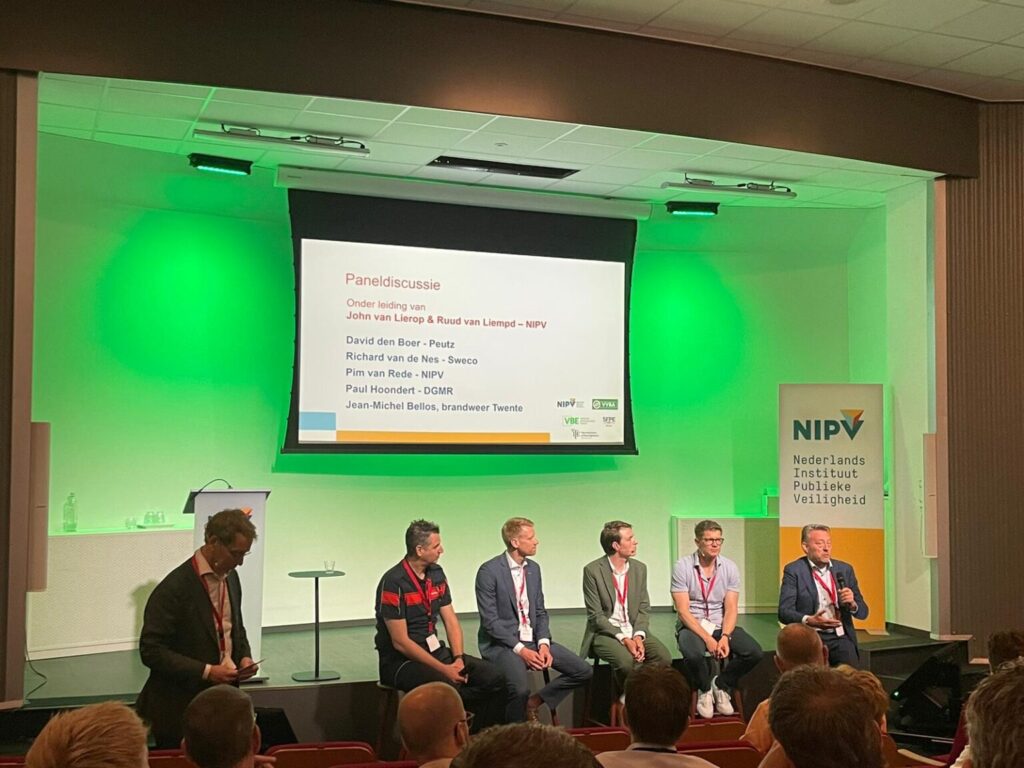
The symposium concluded with a panel discussion in which Jean-Michel Bellos from Twente Fire Department joined the speakers. Together with Ruud van Liempd from NIPV and moderator John van Lierop from SFPE Benelux, the panel explored both the opportunities and limitations of CFD.
The discussion identified several conditions that can support wider and more responsible application:
- Transparent reporting of assumptions, model choices, validation, sensitivity, and uncertainty.
- Appropriate knowledge, skills, and practical experience among CFD users and reviewers.
- Quality assurance processes that match the complexity and consequences of the engineering decision.
- Clearer professional qualifications that help clients and authorities evaluate CFD expertise.
Strengthening CFD practice through knowledge sharing
The Arnhem symposium showed the value of bringing researchers, consultants, authorities, fire services, and professional associations together. Open discussion of both successful applications and current limitations is essential for improving CFD fire simulation practice.
Presentation handouts are available upon request. Contact SFPE Benelux for further information.
Topics: CFD fire simulations · Fire Dynamics Simulator · Fire modelling · Oxygen-controlled fires · Façade fire simulation · CFD quality assurance · SFPE Benelux
Article details
Category
Technical symposium
Published
19 May 2024
Location
Arnhem, the Netherlands
Focus
CFD modelling quality and engineering judgement

Advance fire modelling through professional exchange
Connect with engineers, researchers, authorities, and fire services working to improve the quality and responsible application of CFD fire simulations.